


Disclaimer: The opinions expressed here are that of the writer and do not necessarily represent the views of the Union for Traditional Judaism, unless otherwise indicated.
Question:
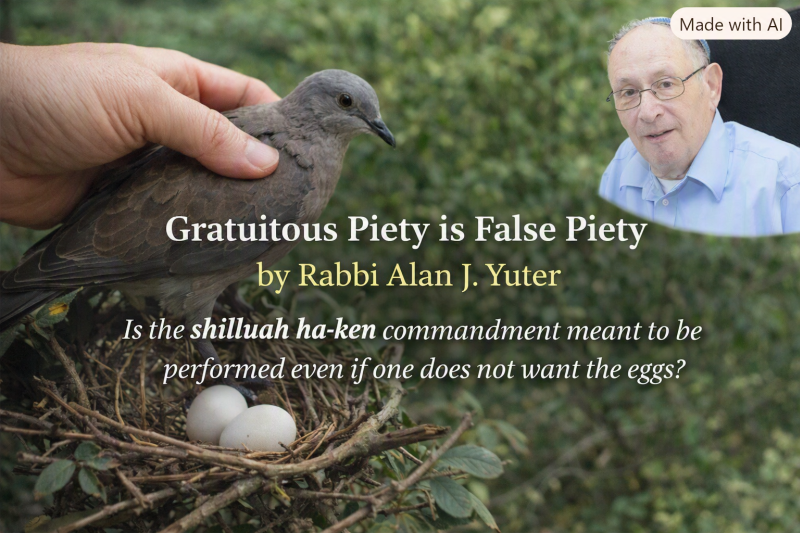
There is a bird nest on a tree outside of my office window, where a pair of birds are patiently waiting for their eggs to hatch.
I was told by a colleague that since shilluah ha-qen [sending away the mother bird before acquiring possession of her eggs or chicks] is a Torah obligation, I ought to chase the mother bird away and take the chicks or eggs, in order to fulfill this Torah obligation.
I have no interest in taking the eggs and disturbing the mother and father birds strikes me as gratuitous and perhaps even cruel. Is the shilluah ha-ken commandment meant to be performed even if one does not want the eggs?
Answer:
Your ethical intuition regarding fulfilling the requirement of sending the mother bird before acquiring possession of the nest’s eggs or chicks is well placed and confirmed by a closer reading of Scripture:
“Ki [= if/when] a bird’s nest chance to be before thee in the way, in any tree or on the ground, with young ones or eggs, and the dam sitting upon the young, or upon the eggs, thou shalt not take the dam with the young.”[1]
This commandment forbids the Jew from taking possession of a nest’s eggs/chicks unless the mother bird is first sent away. The commandment, which only apples to kosher bird species,[2] places a restrictive condition that must be satisfied by one who wants to take the nest’s eggs or chicks; the commandment does not oblige or prescribe that one search for nests to confiscate in order to fulfill this commandment. Significantly, the “if” [=ki] that also opens the very next verse carries the identical semantic valence:
“Ki [= if/when] thou buildest a new house, then thou shalt make a parapet for thy roof, that thou bring not blood upon thy house, if any man fall from thence.”[3]
If/when a person’s roof is habitable, then one is obliged to erect a protective railing on that roof.[4] Similarly, if one wishes to eat meat, kosher slaughter is a prerequisite.[5] Observing the Scriptural norm of sending the mother bird but not using the eggs or chicks constructively violates the prohibition of bal tashkhit, by which a rabbinic norm outlaws pointless, purposeless destruction.[6]
Observing the Torah’s commandments mechanically, as a means to earn salvation credit points, is not an authentic Jewish teaching.[7] Only by compliance with the Torah’s commandments because they are commandments is holiness or sanctity conferred upon the religiously observant Jew.[8]
The commandments should be observed passionately, but not obsessively. By merely performing our daily routines honestly, we observe many commandments.[9] If one is occupied in settling the world,[10] earns an honest living,[11] and is scrupulous with one’s interpersonal relations,[12] there is no reason to engage in religious exhibitionism by trying to appear more worthy, i.e. punctiliously observant, than one is. This latter behavior may be understood as virtue signaling,[13] impression management,[14] and in Halakhic thought, it is disapproved as an unduly prideful presence, mehazi ke-yohora.[15] Rashi insightfully explains that this concept teaches that one not present oneself as an extraordinarily pious person if one is not in fact such a person.[16]
The underlying value concept regarding the suggestion that a good Jew will search out commandments in order to fulfill them. If one wishes to observe more commandments, the Mishnah reports that leaving the gleanings of the corners of one’s fields in support of the poor, bringing first fruits to the Temple, being present at the Temple at the appropriate festival occasions, acts of kindness, and Torah study have no limit,[17] and may repeated to create increased sanctity.[18]
The sacred cannot be owned or possessed. By proclaiming one’s piety, one’s religious behavior is instrumentalized in service of one’s social standing, which is not service of the Giver and Commander, Whose commands alone generate sanctity. If the act is performed because God commanded that it be done, the act is a commandment that sanctifies; if an act is performed to impress other people, the act is a secular instrument IT APPEARS THIS FOOTNOTE IS COVERED BY FOOTNOTE 8 ABOVE of impression management, possibly misplaced pride, and employs falsehood to advance a misleading impression.[19]
[1] Deuteronomy 22:6-7. The translation is taken from the Jewish Publication Society 1917 edition.
[2] Shulhan ‘Arukh Yoreh De’ah 292:1.
[4] Deuteronomy 22:8 and the canonical Midrash Halakhah, Sifre Devarim Ki Teitsei 229, s.v. ve-‘asita me’aeqeh, Maimonides Sefer Hamitzvot positive command 184, which memorializes the legal source of the law, and the negative command 298, which forbids tolerating physical hazards to endanger the community.
[5] Deuteronomy 12:20-21.
[6] Bal tashkhit is Biblically forbidden at Deuteronomy 20:19-20, which outlaws destroying fruit trees during a siege and Rabbinically prohibited is any act of wanton destruction for which there is no constructive purpose, at bShabbat 129a.f
[7] mAvot 1:3 teaches that one “should not be like servants who serve the master in order to receive a reward, but rather be like servants who serve the master without the intent to receive a reward and may the awe of [the God in] Heaven be upon you.” In other words, commandment performance is not viewed instrumentally, as a means to a desired end, but as an end in itself. At mAvot 4:2, Ben Azai teaches (in fact in part based on the mitzvah of shilluah ha-qen, see Midrash Tanhumah Ki Teitze 1:1, Deut. Rabbah 6:4) that the “wage” or “reward” for commandment observance is the opportunity to observe another commandment, and the same consequence applies to trespasses. This Mishnah’s assertion that one ought to perform a commandment and flee from committing a trespass does not contradict our thesis. If one has no desire to collect the nest’s eggs or chicks, there is no commandment to be observed. It is the desire to obtain the chicks or eggs that triggers the commandment blessing.
[8] See, e.g. “… that ye may remember and do all My commandments, and be holy unto your God.” Numbers 15:40. The commandment blessing formula “Who has sanctified us [= Israel] by means of the commandments” reflects this doctrine. Holiness is generated by observing the Torah’s commandments.
[9] The Amora Rava regards the rectitude of one’s business dealings to be the very first criterion by which a person’s life is assessed. bShabbat 31a.
[10] See mSanhedrin 3:3. The consequence—which is not technically compensation—of observing the commandments is sanctification, of being aware that one is in God’s presence. The reward for commandment observance is continued commandment observance See footnote 7 above.
[12] mAvot 4:15, bBerachot 17a and elsewhere.
[13] The “attempt to show other people that you are a good person, for example by expressing opinions that will be acceptable to them, especially on social media.” https://dictionary.cambridge.org/dictionary/english/virtue-signalling.
[14] “Impression management is defined as the processes by which individuals control how they are perceived by others, motivated by the relevance of their public image to achieving desired goals and the existence of discrepancies between their desired and actual perceptions.” AI overview.
[15] bBerakhot 17b. The act under discussion there is reciting the shem’a passages on one’s wedding night, when the sex act is converted from severe prohibition to a sacred, compulsory deed that overrides the shema obligation for that night. Reciting the shem’a in this situation is neither forbidden nor recommended and the act’s propriety ultimately depends upon one’s intention, be-kavvanah talya milta.
Maimonides explicitly permits women to observe the tallit tassel [tsitsit] rite [Hilkhot Tsitsit 3:9], but without the commandment blessing, because women are not obliged to wear the tasseled tallit because tsitsit is a time bound commandment from which women are exempt. At Shulhan ‘Arukh Orah Hayyim 17:2, Maran Karo consistently follows Maimonides by permitting women to wear the tallit without the commandment blessing. R. Isserles invokes the mehazi ke-yohora idiom as a rhetorical device to justify denying women the license to wear tsitsit. Not willing to frontally contradict R. Isserles, R. Eliezer Melammed (Peninei Halacha Likutim 1:8:8) permits women to wear the tsitsit privately, obviating R. Isserles’ concern for mehazi ke-yehora. Classical, canonical Oral Torah law does not attribute unworthy motives to otherwise observant Jews. mAvot 1:6 requires that people should be judged generously, with the benefit of doubt, and mSotah 1:7 reminds the reader that the benchmarks by which one judges others will be the benchmarks that person will her/himself be judged. Mehazi ke-yehora (which appears only in the post-Rav Ashi anonymous, Aramaic setama de-Gemara, with Rav Ashi bringing to closure the authority of a Halakhic supreme court to issue apodictic legislation. bBava Metsia 86a) is the reason that certain behavior was disapproved but not formally forbidden by Israel’s ancient Sages; it is not a meta-Halakhah to be applied willy nilly after the Amoraic period.
[16] Rashi, on the related Mishnah, Berakhot 16b s.v. lo kol ha-rotseh. . If one is able to concentrate, and one is truly pious, then saying the evening shema on one’s wedding night would be permitted.
[18] In the sense that these commandments may be repeated, generating the “payment” of continuing bestowed sanctity, without raising the suspicion of prideful excess. See Maimonides’ commentary to mPe’ah 1:1a, loc. cit.
[19] Exodus 23:7 as understood by bShavu’ot 30b-31a.
Enjoying UTJ Viewpoints?
UTJ relies on your support to promote an open-minded approach to Torah rooted in classical sources and informed by modern scholarship. Please consider making a generous donation to support our efforts.








Educated and first ordained at the Jewish Theological Seminary of America, Rabbi Alan J. Yuter earned additional ordinations from Yeshiva University, supervised by Rav Moshe D. Tendler, and the Israeli Chief Rav Mordecai Eliahu. He further received Yadin Yadin from Rav David Weiss Halivni and earned a PhD in modern Hebrew Literature from New York University.
A founding member of the UTJ, Rabbi Yuter served as a faculty member at the UTJ’s rabbinical school and has held multiple pulpits, including extended stints in Springfield, NJ, and Baltimore, MD.
Rabbi Yuter is a prolific writer on ritual and philosophical issues, underpinnings of halakha, Biblical criticism, and much more. His essays can be found on UTJ’s Viewpoints . He is also a frequent contributor for The Institute of Jewish Ideas and Ideals.
Rabbi Yuter and his wife Linda reside in Israel.