


Disclaimer: The opinions expressed here are that of the writer and do not necessarily represent the views of the Union for Traditional Judaism, unless otherwise indicated.
AI usage note: I drafted the below and then uploaded it to Claude AI for some comments. I integrated some of Claude’s comments.
9/15/26
After some discussion of how to pull off using multiple wicks when making Havdalah on Saturday night that is Yom Tov, I took a quick look at the topic of multiple wicks. Here are some quick items I found of interest. This has not been thoroughly researched. Mostly, I read Rambam and commentaries thereon (including R. Kapach) and Shulhan Arukh and commentaries thereon. I looked quickly at the Talmudic pieces referenced, but without diving into the commentaries thereon.
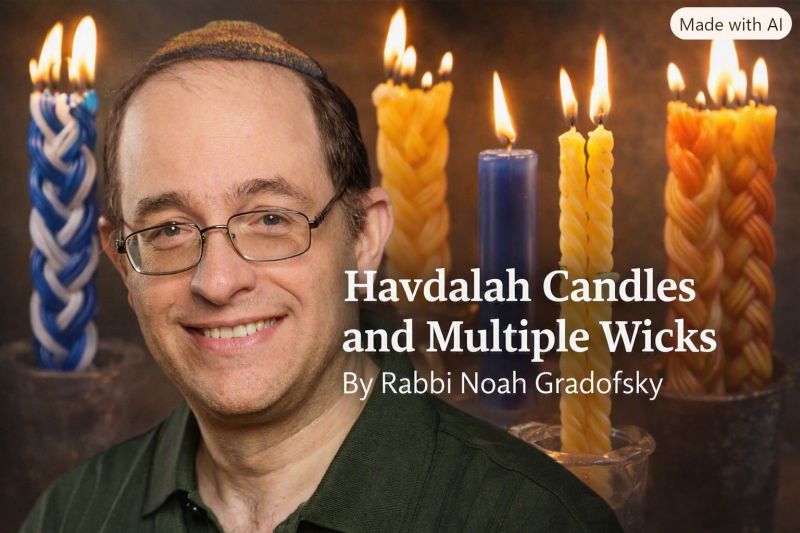
The key to the idea of wanting multiple wicks seems to be the understanding of the term avukah, which is identified as the/a preferred flame for the blessing on a flame at Pesahim 103b. Some commentaries, e.g. Maggid Mishnah on Mishneh Torah Shabbat 29:26 s.v. ואבוקה להבדלה מצוה וכו understand the term to refer to a bundle of wood that provides a lot of light. Maran R. Yosef Karo (Beth Yoseph Orah Hayyim 298 s.v. מצוה מן המובחר) quotes Maggid Misnhah and adds a reference to Sefer Agudah saying that a multiple-wick candle is also a preferred option. R. Moshe Isserles (Orah Hayyim 298:2) says that a candle with two wicks is called avukah. Magen Avraham (Orah Hayyim 298:4) says that two wax candles braided together are considered an avukah (cf. Aruh Hashulhan Orah Hayyim 298:5-6, emphasizing the practical ease with wax candles can be combined and sating that the benefit is that they create more light).
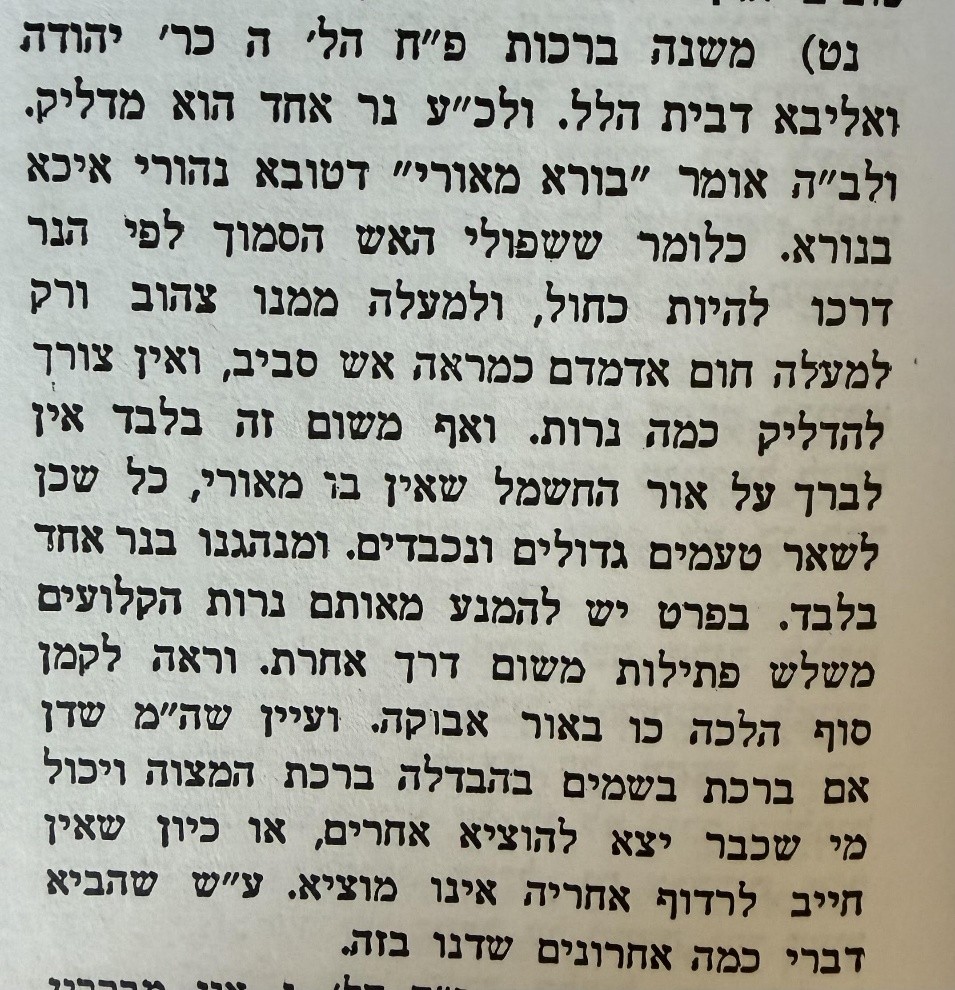
In his commentary on Mishneh Torah, R. Yoseph Kappach (I paste the texts of his comments below) argues that a single wax candle qualifies as the “preferred” flame and states that is the practice in his community. In the Mishnah (Berakhot 8:5 found in the Babylonian Talmud at Berakhot 51b) Beth Hillel and Beth Shamai debate what the proper blessing is on the flame, with Beth Shamai using the singular term מאור and Beth Hillel using the plural term מאורי. In his comment 59 on Mishneh Torah Shabbat 29:24 R. Kapach argues that although Beth Hillel uses a plural term, Beth Hillel and Beth Shamai agree that a single candle is used. R. Kapach notes that the reason for the plural language is explained by R. Yosef at BT 52b as indicating that Beth Hillel argues that a single flame contains multiple lights/flames. R. Kapach, similar to Rashi s.v. הרבה מאורות, explains that this refers to the multiple colors of a single flame. R. Kapach notes that there is no need for multiple candles to justify the use of the word מאורי.
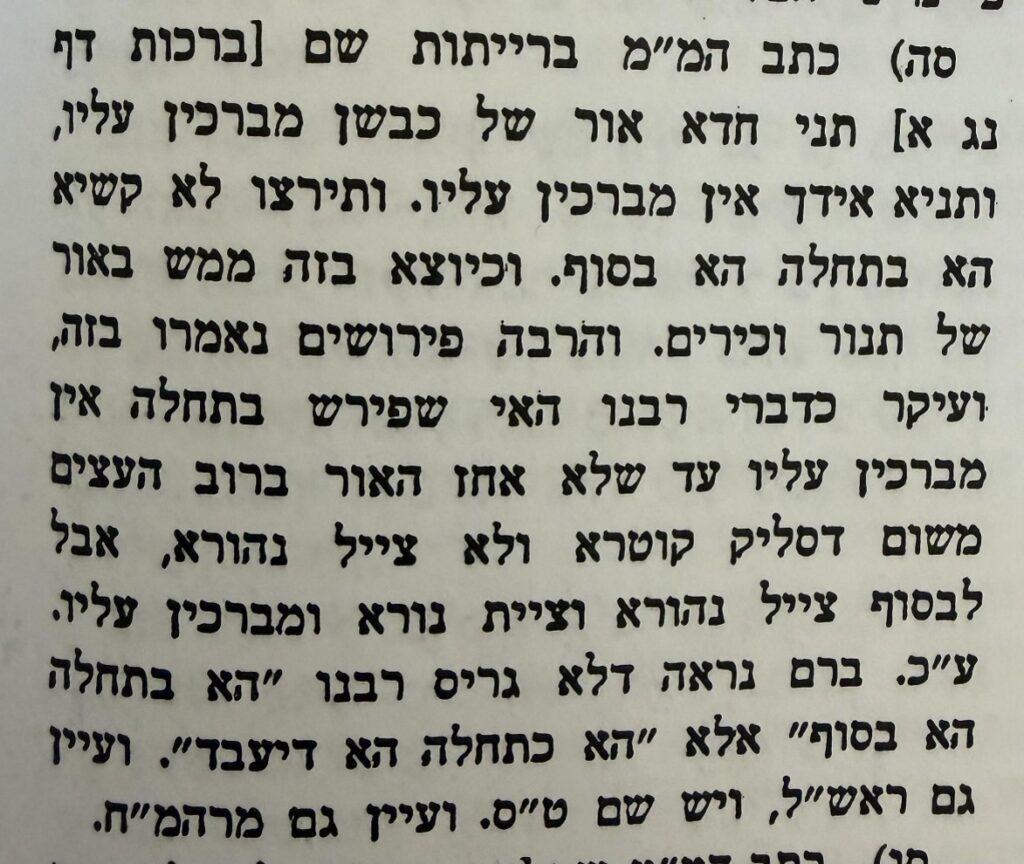
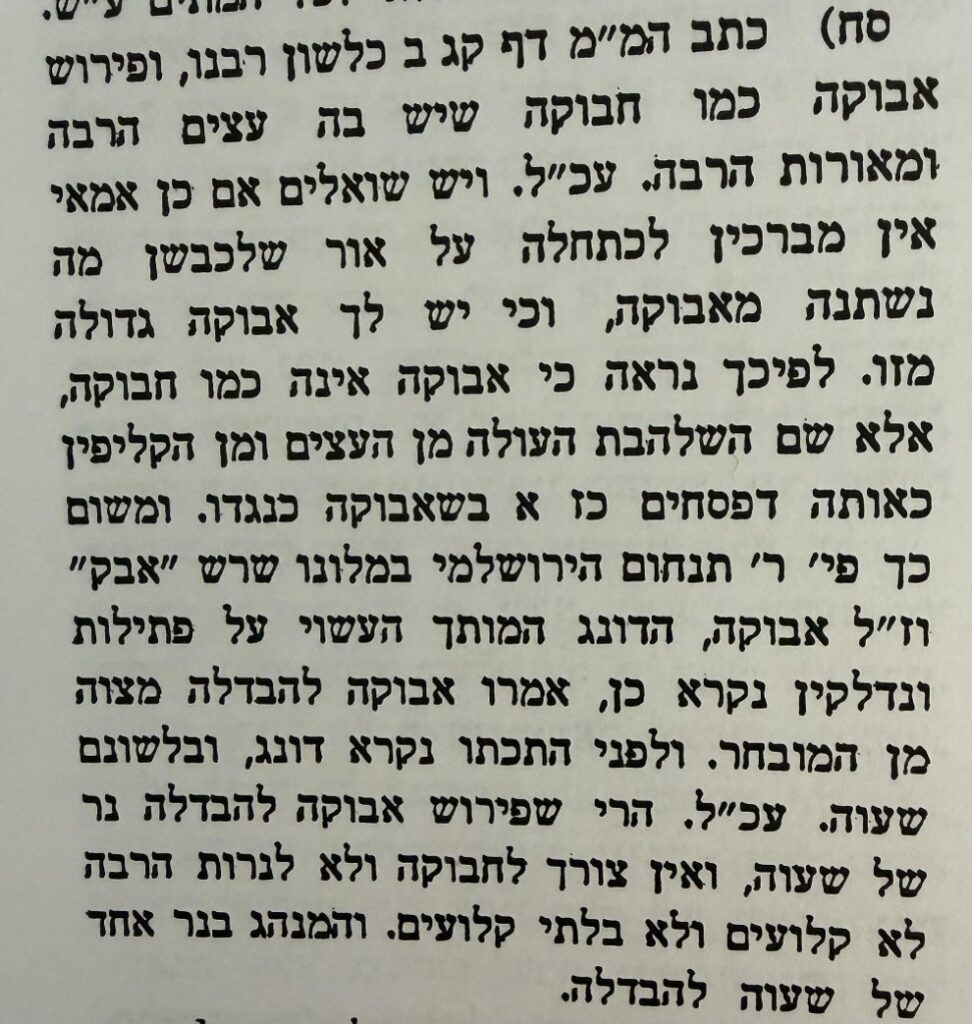
In comment 68 on Mishneh Torah Shabbat 29:26, R. Kapach addresses the definition of avukah. He asks if avukah is a bundle of wood as suggested by the Maggid Mishneh referenced above, why the flame of a furnace, which according to R. Kapach is just a very large gathering of wood, is a less-preferred flame for the blessing. The rule regarding a furnace is found at BT Berakhot 53a and codified by Rambam at Mishneh Torah Shabbat 29:26. R. Kapach (comment 65) understands Rambam as saying that a furnace is a less preferred but valid flame for use for the blessing (i.e. may be used בדיעבד but not לכתחילה), whereas many read the Talmud and Rambam to be saying that a furnace may not be used when it was recently lit (בתחלה) but may be used after it has burned for a while (לבסוף). There are some variant texts of the Talmud that contribute to these possible understandings. R. Kapach argues that avukah as used in the Talmud regarding the blessing on a flame refers simply to a flame coming out of wood or bark. He then notes that Rabbi Tanchum ben Joseph HaYerushalmi in his dictionary on the Mishneh Torah defines avukah as “דונג המותך העשוי על פתילות ונדלקין melted wax that is made onto wicks and lit.” R. Kapach says that the preference is for a wax candle. He concludes that multiple candles are not necessary and it doesn’t matter whether the candles are braided or not, while he says the custom is to use a single candle. However, back in his comment 59 discussed above he writes that there is a reason to avoid a three-wicked candle. He does not specify the reason. Perhaps he still has some concern that such a candle might be akin to the less-preferred furnace or perhaps he simply prefers keeping the custom he knows which is to use a single wax candle, though that would not explain what seems to be an objection particularly to a three-wick candle.
Although R. Kapach’s arguments are interesting and I think relatively convincing, one could argue that the fact that Beth Hillel’s use of the plural term מאורי does not specifically call for multiple wicks, there might be other reasons to prefer multiple wicks (e.g. for the increased light provided by such a flame). Interestingly, the Talmudic sources do not explicitly provide any reason to prefer the light of an avukah. In addition, R. Kapach’s argument that a preference for a bundle of wood (or multiple wicks) is inconsistent with a lack of preference for a furnace is not particularly convincing because it is not at all clear why a furnace is not preferred or whether that lack of preference is only when it was just recently lit. In any event, there is also scant evidence to support a preference for multiple wicks and it is also clear that even if there is a preference for multiple wicks one would still be permitted to say the blessing on the flame of a single-wick candle. Therefore, it seems to me that if a multi-wick candle is easily available one might as well use one, but if there is any particular challenge involved with using a multi-wick candle (for example on Yom Tov) there is no need to engage in a great effort to use multiple flames.
As a side note of interest, R. Kapach in his comment 59 on Mishneh Torah Shabbat 29:26, where he notes that a single flame has many colors and thus justifies the use of the word מאורי, notes that this is an argument against the use of electric light for Havdalah “כל שכן לשאר טעמים גדולים ונכבדים in addition to the other great and honored reasons” against the use of electric light for the blessing on a flame.
R. Kapach Texts
Re the blessing on the flame:
Re: the use of the flame of a furnace for the blessing:
Re: the term avukah:
Enjoying UTJ Viewpoints?
UTJ relies on your support to promote an open-minded approach to Torah rooted in classical sources and informed by modern scholarship. Please consider making a generous donation to support our efforts.



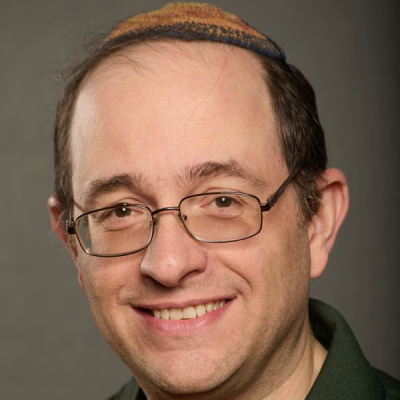
Ordained by the UTJ’s Institute of Traditional Judaism in 2004, Rabbi Noah Gradofsky has remained a steadfast member, serving for years as a member of the UTJ Executive Board, the board of Morashah - UTJ's rabbinic fellowship - and as chairman of the UTJ conference committee.
Rabbi Gradofsky served as a full-time rabbi at Temple Israel in Long Beach, NY, for 6 years and has since served a number of synagogues on a contract basis. He is also a full-time practicing attorney.
Rabbi Gradofsky is also a moderator of the UTJ Facebook group, and he is a prolific writer on Jewish law and sociological topics affecting the religious Jewish community. Among his essays and writings are:
To learn more about Rabbi Gradofsky and access any essays not yet included in Viewpoints, go to: www.e-ark.net
Rabbi Gradofsky is married to Dr. Melissa Klapper and lives in the Philadelphia area.