

by Rabbi Wayne Allen
Disclaimer: The opinions expressed here are that of the writer and do not necessarily represent the views of the Union for Traditional Judaism, unless otherwise indicated.
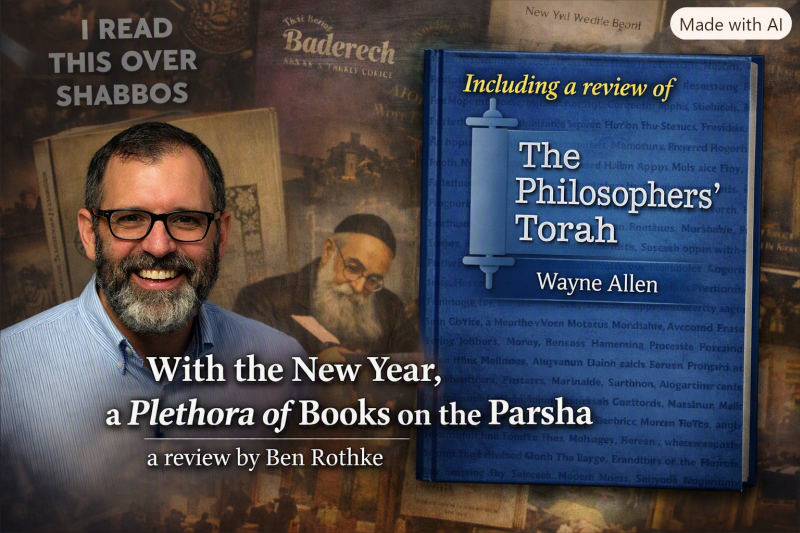
In his article appearing in the Jewish Link and on his Times of Israel blog, Ben Rothke reviews new books on the parashah, including “The Philosophers’ Torah” by UTJ Viewpoints Contributor Rabbi Wayne Allen.
Copied below, with permission, is the revewi of “The Philosphers’ Torah.” For the full article, follow the links above. Below also find Amazon links (where available) for purchasing each of the books reviewed by Rothke. As a reminder, UTJ is a participant in the Amazon Services LLC Associates Program, an affiliate advertising program designed to provide a means for sites to earn advertising fees by advertising and linking to Amazon.com.
If you have ever wanted to know what Socrates, Hegel, Diderot, or other philosophers had to say about the parsha, then The Philosophers’ Torah (Maimon Books) by Rabbi Dr. Wayne Allen is the book for you.
Allen takes the philosophical ideas of more than 70 major secular philosophers from the last 3,000 years and maps them onto various parsha ideas.
Eichah Rabbah states: “If someone tells you, ‘There is wisdom among the nations,’ believe it. If he tells you, ‘There is Torah among the nations,’ do not believe it.” You won’t be saying birchat haTorah on this book, but it does offer a fascinating look at the wisdom of these philosophers.
Philosophy has had an often contentious journey with Judaism. Perhaps the most famous example is the medieval ban on studying philosophy. The bans of 1232–1234 centered on Maimonides’ philosophical works, especially the Guide for the Perplexed (Moreh Nevukhim) and the portions of the Mishneh Torah dealing with philosophy and theology. Maimonides used Aristotelian philosophy to explain Judaism, and some rabbis feared that this encouraged young Jews to abandon traditional belief and Torah study.
Here, Allen shows how biblical texts have long influenced philosophy. To a degree, therefore, philosophy need not be viewed as something external to Torah.
While most biblical commentaries take a forward approach – the verse says A, and the commentator explains B. Allen takes a backward approach: he starts with a verse and then finds great philosophers who can contribute to understanding it.
Shiv’im Panim laTorah is a rabbinic phrase meaning “the Torah has 70 faces,” used to indicate different levels of interpretation. Perhaps one of those 70 is the way of philosophy. The book shows how questions that philosophers have wrestled with for centuries can offer another lens through which to understand the Torah.
These philosophers have dealt with many of the same issues the rabbis have explored: free will versus determinism, good and evil, the purpose of law, the meaning of suffering, and much more.
About a third of the book covers Sefer Beresheet, which is fertile ground for philosophical inquiry. Questions such as why God created the universe and whether creation requires a cause naturally arise. In fact, Allen could have written an entire work on Sefer Beresheet given the number of philosophical questions it raises.
Some of the most compelling ideas he explores include the Flood: why punish humanity if God is omniscient? The Binding of Isaac: can morality conflict with God’s command? Sodom: Abraham challenges God—and much more.
The book demonstrates the kind of wisdom that can be found among the nations, and Wayne Allen makes a compelling case for engaging with it.
Read the full article on the Jewish Link or on Ben Rothke’s Times of Israel blog.
Amazon links (where available) for books reviewed by Ben Rothke:
Enjoying UTJ Viewpoints?
UTJ relies on your support to promote an open-minded approach to Torah rooted in classical sources and informed by modern scholarship. Please consider making a generous donation to support our efforts.



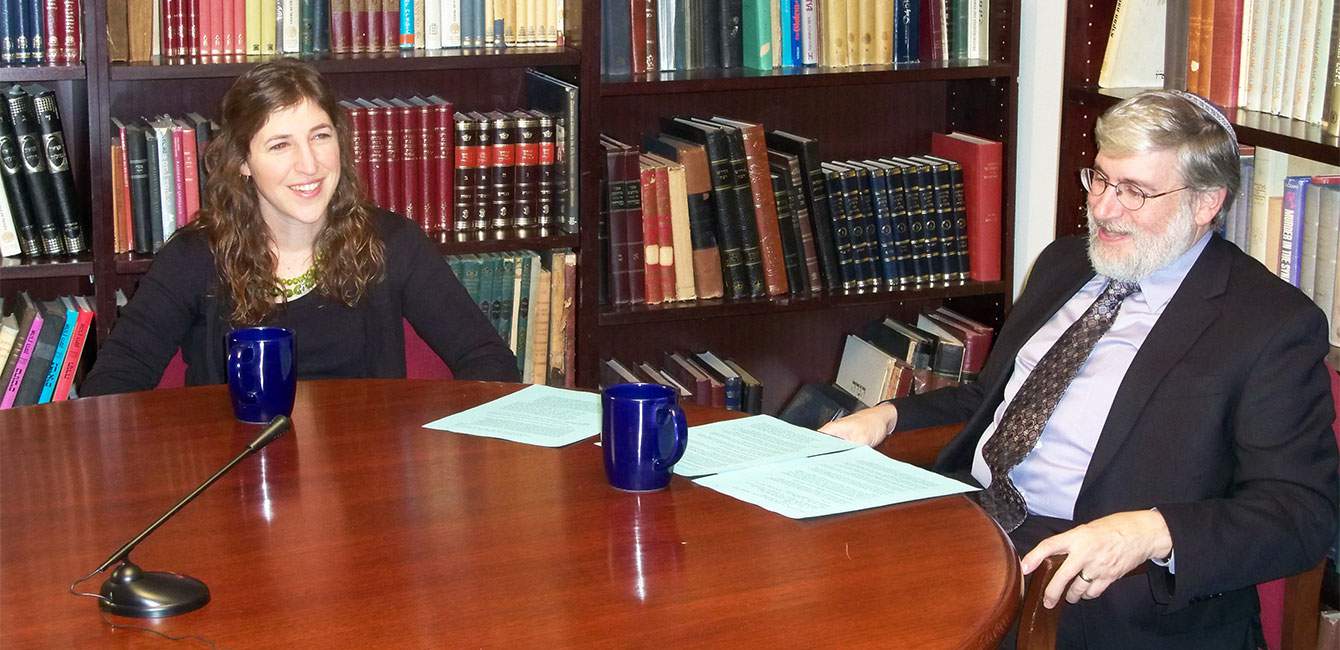


Samples of Rabbi Allen’s teaching are accessible on his website, www.rabbiwayneallen.ca.
Rabbi Allen's published books, available from the UTJ Bookstore are: