

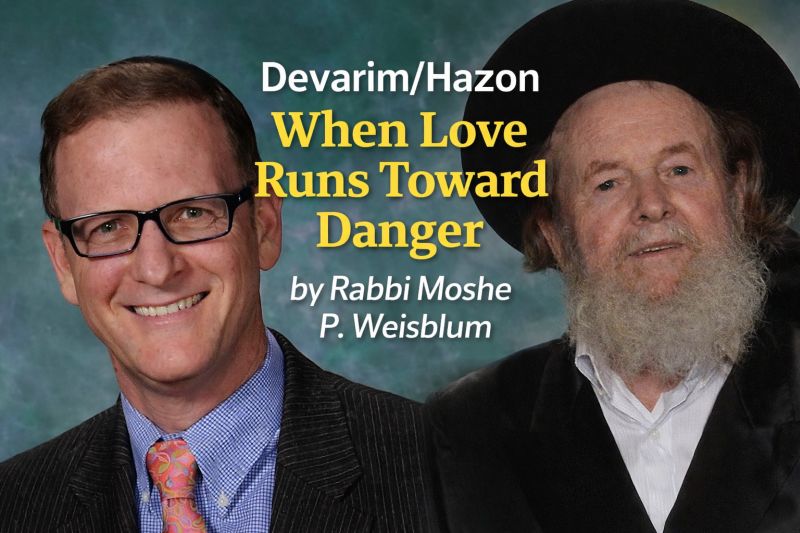
by Rabbi Moshe P. Weisblum
Disclaimer: The opinions expressed here are that of the writer and do not necessarily represent the views of the Union for Traditional Judaism, unless otherwise indicated.
Shabbat Shalom everyone,
My father, of blessed memory, was a great man. A Chassidic rav in Haifa, with a long beard and long peyot and a black hat. His physical appearance caused people to misjudge him. Still, my father was always kind and was there to help anyone; Orthodox or non-Orthodox. My father believed that every soul was precious. He gave everyone the benefit of the doubt.
I clearly remember being about seven years old, joining my father as we traveled to Tel Aviv where he was to officiate a wedding. I was very excited to go to a new city. Just the two of us, on the bus from Haifa. In Tel Aviv we were to transfer to a bus within the city. I remember being proud to be next to my Dad.
When we got off the bus in Tel Aviv, there was a wide road in front of us. Six lanes. Three going one way, three going the other. And ahead of us, walking toward that road, were two young women. Secular women. Each of them dragging a heavy suitcase. And I could see they were about to cross all six lanes right there, in the middle, instead of walking the short distance to the crosswalk.
My father saw it too. And my father, who understood exactly how dangerous that road was, hurried toward them. Very politely. In the gentlest voice. He said to them, more or less: “Dear ladies, I am teaching my son the importance of safety on the road. Come, let us go to the crosswalk and cross together. It’s a short walk from here but much safer.”
He was not scolding them. He was not preaching. He was kind and pointed out the danger in a non-confrontational way. They looked at this Chassidic Jew with the beard and the black hat, and they laughed. “Who are you? Who asked you? Mind your own business!” Cruel, humiliating words. And I stood there, a young child, next to my father, and I felt ashamed. Ashamed for him. Ashamed of the way they looked at him.
They turned away from him. And they stepped into the road.
We walked on, slowly, toward the crosswalk, the way he had asked. They were already out in the lanes. It happened in a heartbeat. A car came.
I will not describe what I saw as a child. It is enough to say that in a single moment, both of those young women were gone. Right there in front of us. And I looked up at my father. And for the first time in my life, I saw my father cry. This great man, this rav, standing at the edge of that road with tears running down into his beard. Not saying, “They should have listened.” Not saying, “They laughed at me.” Just weeping. Weeping for two strangers who had pushed him away sixty seconds earlier.
That image has never left me.
My father saw one of our neighbors nearby and asked her to watch me while he ran to the road and stayed to help until the ambulance arrived.
He asked me not to tell anyone, to spare others the trauma. I learned many lessons that day: not to judge, always help, not to hold grudges, and not to cause unnecessary agony.
All these years later, I still see him standing there with tearful eyes. My Dad exhibited the quality of a compassionate leader. He somehow reminded me of Moses.
I thought about my father this week, because this Shabbat we begin the last book of the Torah. Sefer Devarim. And this Shabbat has a name. It is called Shabbat Chazon, the Shabbat of vision, the Shabbat right before Tisha b’Av, the saddest day of our year. And here is what is strange about Devarim. For four whole books, Moses has barely spoken in his own voice. Always it is, “And our Creator spoke to Moses, saying.” Moses receives, Moses passes it on. He is the messenger.
But the fifth book opens differently. “Eleh ha-devarim asher diber Moshe.” These are the words that Moses spoke. For the first time, the words are his own. This is a man with about five weeks left to live, standing at the edge of a river he has been told he will never cross, looking at the people he carried on his back for forty years.
And what does he choose to say, with the little time he has left?
He tells them the truth.
The book opens with a list of place names. Strange names that do not match any map. And Rashi tells us these are not places at all. Each one is a hint at a sin. A hint at the golden calf. A hint at the complaining. A hint at the rebellion. Moses is holding up a mirror to his people. He is telling them, one last time, where they went wrong. But look how he does it. He does not stand up and shout, “You sinned here, and here, and here.” He hides it. He wraps it. He says only the names of the places, so gently that a person can hear the truth without being crushed by shame. Even when Moses corrects them, he protects their dignity.
The hardness is in the content. But the gentleness is in the way he says it. And this is not just a nice instinct. It is the law. Our sages teach that we are commanded to correct one another, but that a rebuke which shames a person in public is itself a sin. The whole art is to say the true thing, and to say it in a way that the other person can actually receive. Moses, in the opening words of his last book, is showing us how. And that, to me, is my father on that road in Tel Aviv. Because Moses is doing exactly what my father did. He is running toward people who have every reason to push him away. This is a generation that complained about him, rebelled against him, doubted him for forty years. And instead of writing them off, instead of saying “you laughed at me, you rejected me, you are on your own,” he runs toward them one more time. Gently. With love. To try to bring them safely across.
There are two things I want to leave you with this morning. My father taught me both of them on that road, though it took me many years to understand. The first is this: You run toward the people who push you away. It is easy to love the people who love you back. Anyone can do that. The real test of a person is what you do with the one who laughed at you. The one who dismissed you. The one who does not think you have any right to speak into their life. Love is not measured by who we welcome. It is measured by who we refuse to give up on. My father had every excuse to keep walking. He had been mocked before for his hat, his beard, everything he was. But he still ran toward two women who were clearly not Orthodox. Because when you see someone in danger, their opinion of you stops mattering. Only they matter.
This is what our tradition calls the opposite of _sinat chinam_. We are about to mourn, on Tisha b’Av, a Temple that was destroyed, our sages tell us, because of sinat chinam. Baseless hatred. People who could not see past their contempt for one another. And the answer to baseless hatred is not agreement. It is not pretending we are all the same. The answer is a man who runs across a road toward two women who just laughed in his face, because he cannot bear to see them come to harm. And the second thing is harder. It is about time.
My father was only a short distance away. If they had listened, if they had walked with him just a little further, they would have lived. The tragedy was not that they were bad people. They were not. The tragedy was that the crossing was right there, and they did not reach it in time. And I think about how much of our lives are exactly that. A short distance. A few steps we keep meaning to take.
There is a conversation you have been meaning to have. With a parent who is getting older. With a child who has drifted. With a brother or a sister you have not spoken to in years. You know the words. You have even started typing them into your phone, and then deleted them, and put the phone down.
And you tell yourself, there is time. I will do it next month. Next year. When things are calmer.
Moses waited forty years to say his hard words. Perhaps that was patience, waiting for the moment they could finally hear him. But it is also a warning. Because Moses barely made it. He got the words out at the very edge of the river.
Most of us are not promised that we will reach the edge of the river with our words still unsaid but sayable. Most of us do not get the warning.
So this is what I want to ask of you, on this Shabbat Chazon, this Shabbat of vision.
See the road clearly. That is what Chazon means. Vision. The ability to see what is really in front of you.
See the person you have been meaning to reach. And see that the crosswalk is still open. Right now, this week, you can still walk it. The hard conversation you have been avoiding, you can still have it, and you can have it the way Moses had it, and the way my father tried to have it. Not as an accusation. Not as “I told you so.” But gently. With love audible inside every word. Running toward them, not away.
Do not wait until you are at the edge of your own river, with the words still stuck in your throat.
My father stood on that road and wept because he was a few steps too far, and a few seconds too late, to save two strangers who did not want his help. I have spent my whole life trying to be a little faster than he was allowed to be that day. To reach the person before the road does.
That is the whole of Sefer Devarim. A man running toward the people he loves, with the little time he has left, saying the true thing gently, so they can cross over safely to the other side.
May we find the courage to run toward the ones who pushed us away. May we speak the hard, loving word while there is still time. And may we always reach one another before the road does.
The Word We Mean to Say
By Moshe P. Weisblum
There is a word we mean to say,
and mean to say some other day.
Let this now be the day we speak,
before the strong forget the weak.
Teach us to tell the truth with care,
to name the wound and yet be fair,
to say the hard thing, plain and true,
the way that love would want us to.
Give us the heart to turn, not flee,
to those who cannot yet agree,
to cross the road that keeps us far,
and reach each other where we are.
The crossing waits, the light is green,
the little space that lies between.
Let us not stand and watch it close,
but walk it while the mercy shows.
Grant us the vision, clear and whole,
to see the road, to see the soul,
to see what still can be repaired,
and say the word we never dared.
And may we come, when all is done,
across the water, every one,
the ones we lost, the ones we hold,
into the light, into the fold.
Shabbat shalom!
Enjoying UTJ Viewpoints?
UTJ relies on your support to promote an open-minded approach to Torah rooted in classical sources and informed by modern scholarship. Please consider making a generous donation to support our efforts.



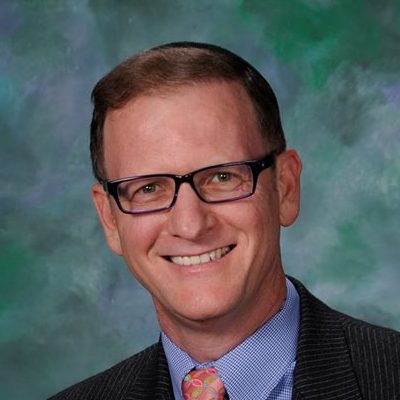
Born in Sde Ya’akov, Israel, Rabbi Moshe Pinchas Weisblum, PhD is a 14th generation rabbi in his family's dynasty of rabbinical leaders. His great grandfather was the famous Tzadik Rabbi Elimelech Weisblum of Lizhensk, Poland, one of the great founding Rebbes of the Chasidic movement and author of the brilliant book of commentary on the Torah: Noam Elimelech. His grandfather (from his father's side) was the well known Zidichov Rebbe - Rabbi Ya’akov Yitzchak Weisblum. He is the son of renowned scholar, former Rosh Yeshiva of Sde Ya’akov and the Rabbi of Neve Sha'anan neighborhood in Haifa for over 50 years - Rabbi Chaim Naftali Weisblum, and the grandson (from his mother's side) of the famous Kabbalistic master and author, Rabbi Yehuda Zvi Brandwein.
Rabbi Moshe P. Weisblum studied at Yeshivat Torat Emet, Haifa, from 1968 to 1976, at Yeshivat Itri from 1976 to 1978, and was a student at Yeshivat Ohr Etzion from 1978 to 1980.
Rabbi Weisblum earned a Masters Degree in Public Administration from Fairleigh Dickinson University, New Jersey, and earned a PhD in Philosophy from Baltimore Hebrew University. He also had an aptitude for computer skills, in networking, earning an A+ certification. Further, he was awarded the Sidney Breitbart Prize in Jewish philosophy from Baltimore Hebrew University in 2005.
Rabbi Weisblum was also a consultant to the media, since 1991.He was on a TV interview, channel 12-talk show, cable TV channel 54 –commentator on social and political issues. He was interviewed on the radio many times, regarding political and religious analysis and consulted on Middle Eastern affairs to Washington D.C.
He is a member of the New York Board of Rabbis, New Jersey Board of Rabbis, Union of Traditional Judaism, and Morasha Rabbinic fellowship.
Rabbi Weisblum has published a number of books including "Table Talk Biblical Questions and Answers" and "Ruth Talk", which is loaded with questions and answers on the Book of Ruth. In 2007, his book "The Hermeneutics of Medieval Jewish Thoughts Understanding the Linguistic Codes of Rashi and Nachmanides" was published by the Edwin Mellen Press. A review of this book can be found on the Mellen Press Web site.
Rabbi Weisblum is an accomplished musician as well. His album Heartfelt Melodies is available on Amazon and his popular YouTube channel features close to 3000 videos including Daf Yomi, Torah and Haftarah cantillation, lectures, music videos, and more.
Rabbi Weisblum is blessed with five children and eleven grandchildren and serves as a spiritual leader, lecturer and University Professor.