


by Rabbij Moshe Weisblum
Disclaimer: The opinions expressed here are that of the writer and do not necessarily represent the views of the Union for Traditional Judaism, unless otherwise indicated.
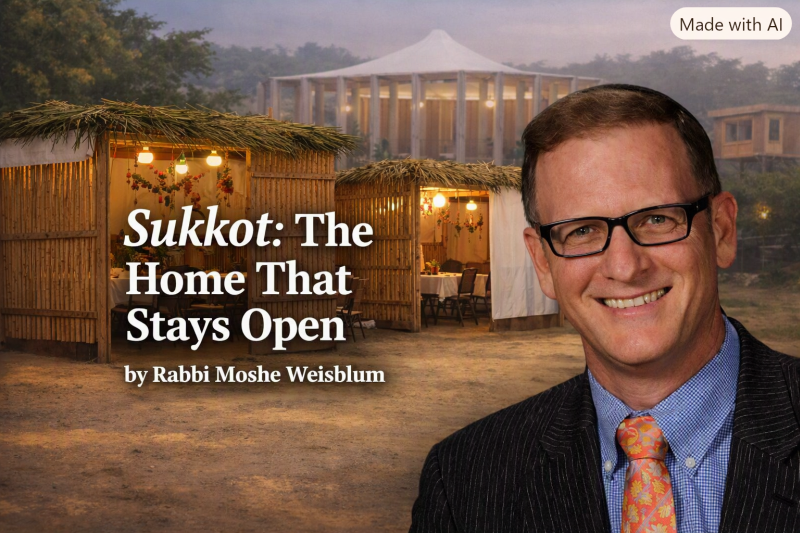
SUKKOT: THE HOME THAT STAYS OPEN
In January of 1995, an earthquake struck Kobe, Japan. Thousands of buildings collapsed. Families who had gone to sleep believing they were safe woke to find the walls around them gone.
In the Nagata district, among those left without shelter, was a community of Vietnamese refugees. They already knew what it meant to leave one home behind. Now they had lost another. They were living beneath thin plastic sheets in a park, exposed to the weather, uncertain what would come next. Takatori Catholic Church, where many of them had worshiped, had burned to the ground.
A Japanese architect named Shigeru Ban came to see them. He did not arrive with marble, steel, or concrete. He came with an idea that sounded absurd.
He would build houses out of paper.
Ban designed small cabins with walls of tightly rolled paper tubes. The foundations were donated beer crates weighed down with sandbags. Tent material formed the roofs. Volunteers built them together. The materials were simple and inexpensive. The structures were temporary. But to the people who walked inside, they offered more than protection from the weather. They offered privacy, dignity, and the first feeling of home.
Then Ban and his volunteers built that same community a church, also out of paper tubes. It took five weeks and a hundred and sixty pairs of hands. Further information and pictures of Ban’s work can be found here, here, and here.
Years later, when a permanent church was built on the site, that paper sanctuary was carefully taken apart and shipped to Taiwan, where another village had been broken by another earthquake. It was raised again there. It became a gathering place a second time.
Think about that. A church made of paper outlived the disaster that brought it into being. A temporary building found a second home and helped another community find its own.
Shigeru Ban later received the Pritzker Prize, architecture’s highest honor. But the deeper honor was already standing in Kobe. He had shown that the strength of a building is not measured only by the strength of its materials. Sometimes the most fragile structure restores the strongest human dignity.
There are few words in any language more comforting than these: “I am home.”
Home is where we lower our guard, set down what we have been carrying, and allow ourselves to breathe. Home is supposed to be the place the world cannot reach.
And then Sukkot arrives and asks us to do something unreasonable.
Leave the solid house.
Step outside.
For one week, Jewish families build and gather in a sukkah: a small hut with walls that are not quite walls and a roof of cut branches laid loosely overhead, open enough that rain can come through and the stars can be seen at night. We eat there. We welcome guests there. Some of us sleep there.
For one week, tradition moves us from permanence into fragility. Why? What can a temporary hut teach us about building a lasting life?
Perhaps it begins with a distinction we forget. A house and a home are not the same thing.
A house is made of materials. A home is made of relationships. A house has a market value. A home has a human value. A house can be measured in square feet. A home is measured in the safety people feel when they walk through the door.
Some people live in magnificent houses and never feel at home. Others gather in modest rooms where everyone who enters feels seen and welcomed. The difference is not architecture. The difference is presence.
Frank Lloyd Wright spent his career insisting that a building should not merely stand on the land but belong to it. At Fallingwater he set a house above a waterfall and let the stone, the light, and the sound of the stream become part of the living space. Nature was not an enemy to be shut out. It was invited in. The sukkah had been making that argument for thousands of years, and making it about the heart as much as the land.
Its roof gives shade but leaves us aware of the sky. Its walls surround us but do not pretend to make us invulnerable. The sukkah offers shelter without the illusion of control.
That may be the most honest lesson any building can teach.
We spend our lives trying to make everything secure. We build plans, careers, reputations, savings, routines, and walls. There is wisdom in preparing for tomorrow. But Sukkot reminds us that no wall can guarantee that life will unfold as planned.
A single phone call can divide a life into before and after. Health changes. Work changes. The world itself changes while we are making plans for another day.
This is not a message of fear. It is a message of freedom.
If absolute security was never ours to hold, we can stop exhausting ourselves pretending otherwise. We can loosen our grip. We can notice the people beside us. We can be grateful while what is precious is still here.
The sukkah does not say, “Nothing can happen to you.” It says, “Whatever happens, you do not have to face it alone.”
That is a message the whole world needs.
Across nations, cultures, and faiths, people are searching for home. Some have been displaced by war or disaster. Others live in comfortable houses filled with loneliness, surrounded by people who do not really know them. They carry a private homelessness of the heart, the feeling of being welcome nowhere exactly as they are.
So Sukkot asks a second question. Not only, “Where is my home?” but, “Who feels at home in my presence?”
Do people feel safe speaking honestly with me?
Does my family receive my attention, or only what is left of it?
When someone arrives carrying sorrow, do I make room for it, or hurry to change the subject?
When a stranger stands at the edge of the circle, do I notice?
Hospitality sits at the center of this festival. Jewish tradition speaks of ushpizin, honored spiritual guests symbolically welcomed into the sukkah each night. The custom teaches that a sacred space is never built for one person alone. The holiness of a home is revealed by whom it is willing to receive.
The most beautiful decoration in any sukkah is not hanging from the roof. It is the empty chair pulled close for someone who thought there was no place for them.
Our world has become more connected and, in many ways, more isolated. We speak across continents in seconds and fail to look into the eyes of the person across the table. We collect followers and feel unseen. We fill every quiet moment with information and leave no room for reflection.
The sukkah interrupts that. It asks us to sit together under a simple roof. To share food. To tell stories. To hear the wind. To look up.
Looking up may be the deepest practice of this week. When we see only the walls around us, life narrows to our problems, our deadlines, our disappointments. Through the open roof we remember that there is still a sky. The struggle is real. It is not the whole horizon.
The sukkah does not remove hardship. It gives hardship perspective.
It teaches something surprising about joy as well. Sukkot is called z’man simchateinu, the season of our rejoicing. Yet this festival of joy seats us in a fragile hut. We might expect joy to be celebrated inside the strongest building, after every problem has been solved. Instead we are told to rejoice now, beneath a roof that moves with the wind.
This is mature joy. It is not denial. It does not claim that the world is painless or that every prayer has been answered. It is the courage to say: life is uncertain, and still there is beauty. The future is unwritten, and still there is love.
We do not postpone joy until life becomes unbreakable. If we did, joy would never arrive.
Perhaps that is why the sukkah feels so alive. Rain falls. A decoration sways. A chair rests unevenly on the ground. And still people gather, children laugh, blessings are spoken, and a temporary structure becomes the setting for a permanent memory.
Years from now, few people will remember whether the sukkah was perfectly built. They will remember who sat beside them. The song. The laughter. The familiar story. The hand that reached across the table. We imagine that permanence comes from stronger materials. More often it comes from deeper attention.
The things that last longest are not always the things built to last.
So this Sukkot, let us ask what kind of home we are building, not only with wood and canvas and stone, but with our words and our choices. A home where disagreement does not erase dignity. A home where success is celebrated, pain is not hidden, and forgiveness is possible. A community where the elderly are honored, children are heard, newcomers are welcomed, and no one has to earn the right to belong.
And when we step out of the sukkah and return to our solid houses, may we carry its openness with us. A little more room in our schedules. A little more room at our tables. A little more room in our hearts.
May the lonely find companionship. May the frightened find reassurance. May those far from home find a door that opens.
We began by saying that home is where the world cannot reach us. Sukkot offers something wiser. Home is not where we hide from the world. Home is where we gather enough love and courage to go back out into it and help repair it. A house protects the body. A home protects the spirit. And the heart that is safest is not the one that closes. It is the one strong enough to stay open.
The paper walls in Kobe were never meant to last. Neither is the sukkah. Yet both reveal what stone alone cannot teach. Permanence is not always found in what remains standing. Sometimes it is found in the dignity we restore, the shelter we offer, and the love another person carries away.
I would like to close with these words:
The Home We Carry
When every wall we trusted falls away,
And night arrives before the close of day,
One open hand can lead us through the dark,
And keep alive one small, uncertain spark.A home is not the timber or the stone,
It is the place where no one stands alone.
It lives within the chair set by our side,
The quiet voice that says, “Come sit inside.”The roof may bend, the branches shift and lean,
And through their gaps the quiet stars are seen.
These walls were never built to promise more
Than warmth, and one another, and a door.The hands that raised a house of paper there
Made more than shelter from the open air.
They gave the uprooted a place to rest,
And with that gift the giver too was blessed.So leave the doorway open through the years
For strangers carrying their hopes and fears.
Though walls may fall and all we own depart,
We carry “I am home” within the heart.
Amen.
Enjoying UTJ Viewpoints?
UTJ relies on your support to promote an open-minded approach to Torah rooted in classical sources and informed by modern scholarship. Please consider making a generous donation to support our efforts.



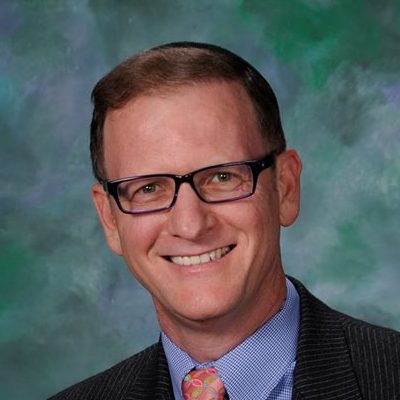
Born in Sde Ya’akov, Israel, Rabbi Moshe Pinchas Weisblum, PhD is a 14th generation rabbi in his family's dynasty of rabbinical leaders. His great grandfather was the famous Tzadik Rabbi Elimelech Weisblum of Lizhensk, Poland, one of the great founding Rebbes of the Chasidic movement and author of the brilliant book of commentary on the Torah: Noam Elimelech. His grandfather (from his father's side) was the well known Zidichov Rebbe - Rabbi Ya’akov Yitzchak Weisblum. He is the son of renowned scholar, former Rosh Yeshiva of Sde Ya’akov and the Rabbi of Neve Sha'anan neighborhood in Haifa for over 50 years - Rabbi Chaim Naftali Weisblum, and the grandson (from his mother's side) of the famous Kabbalistic master and author, Rabbi Yehuda Zvi Brandwein.
Rabbi Moshe P. Weisblum studied at Yeshivat Torat Emet, Haifa, from 1968 to 1976, at Yeshivat Itri from 1976 to 1978, and was a student at Yeshivat Ohr Etzion from 1978 to 1980.
Rabbi Weisblum earned a Masters Degree in Public Administration from Fairleigh Dickinson University, New Jersey, and earned a PhD in Philosophy from Baltimore Hebrew University. He also had an aptitude for computer skills, in networking, earning an A+ certification. Further, he was awarded the Sidney Breitbart Prize in Jewish philosophy from Baltimore Hebrew University in 2005.
Rabbi Weisblum was also a consultant to the media, since 1991.He was on a TV interview, channel 12-talk show, cable TV channel 54 –commentator on social and political issues. He was interviewed on the radio many times, regarding political and religious analysis and consulted on Middle Eastern affairs to Washington D.C.
He is a member of the New York Board of Rabbis, New Jersey Board of Rabbis, Union of Traditional Judaism, and Morasha Rabbinic fellowship.
Rabbi Weisblum has published a number of books including "Table Talk Biblical Questions and Answers" and "Ruth Talk", which is loaded with questions and answers on the Book of Ruth. In 2007, his book "The Hermeneutics of Medieval Jewish Thoughts Understanding the Linguistic Codes of Rashi and Nachmanides" was published by the Edwin Mellen Press. A review of this book can be found on the Mellen Press Web site.
Rabbi Weisblum is an accomplished musician as well. His album Heartfelt Melodies is available on Amazon and his popular YouTube channel features close to 3000 videos including Daf Yomi, Torah and Haftarah cantillation, lectures, music videos, and more.
Rabbi Weisblum is blessed with five children and eleven grandchildren and serves as a spiritual leader, lecturer and University Professor.